Why Government & Institutional Buildings Specify Alucobond Ghana
A ministry building, an agency headquarters, or a civic institution carries a public obligation that an ordinary commercial tower does not. It is funded under public procurement, it is occupied by hundreds of staff and visitors, and its façade is read as a statement of the state’s seriousness about safety and stewardship. Alucobond Ghana has specified and installed aluminium-composite (ACP/ACM) façades across Greater Accra since 1977, and in the public sector our discipline is exactly what procurement demands: we name the panel core, certify its fire class, and hand over the paper trail that proves what is on the wall.
Government commissions cluster around Ridge, the Ministries enclave, the CBD, and the newer agency campuses in Airport City. These are high-occupancy buildings under public scrutiny, and the post-Grenfell shift in façade fire awareness applies directly: a public institution should not carry a combustible PE-core envelope. We specify to the building’s height and occupancy, not to the lowest line in the bill.
What Government Façades Demand
Documented fire performance and core disclosure
The panel core decides fire behaviour — PE (combustible), FR (~70% mineral filler), or A2 (>90% mineral filler, classified A2-s1,d0 to EN 13501-1) — and public buildings should never carry an undisclosed core. For occupied ministry and agency buildings we specify FR or non-combustible A2 cores and supply the EN 13501-1 classification as procurement evidence.
Procurement-grade documentation
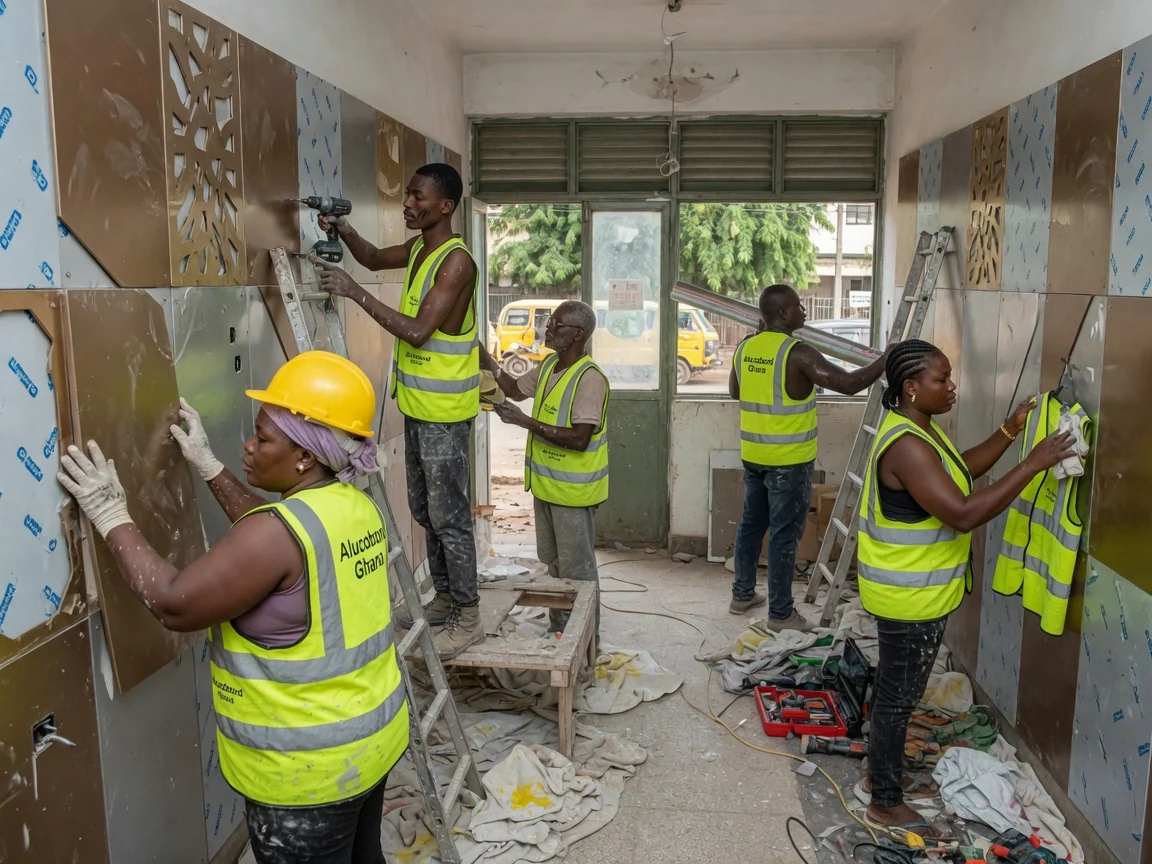
Public-sector work runs on auditable paper: panel data sheets, fire classifications, sub-frame execution records and as-installed detail. We structure the handover package so a public works inspector or audit can trace every panel to its certification.
Durability across administrations
Civic façades are specified to outlast the administration that commissioned them. Anodised and PVDF/FEVE-coated panels hold colour and line across decades of Accra climate, keeping maintenance demand low on the public purse.
Our Government Cladding Scope
- Fire-Rated ACP Cladding (PE vs FR vs A2) — core selection and EN 13501-1 documentation for high-occupancy public buildings
- Commercial ACP Cladding — ministry and agency tower façades fabricated and installed as a system
- Signage & Wayfinding — institutional identification, crests and public wayfinding in panel
- Retrofit & Re-Cladding — replacing combustible legacy panels on existing public buildings
- ACP Cladding Cost Guide — how core, height and access drive the survey figure
Standards & Fire Safety
- EN 13501-1 — European reaction-to-fire classification (Euroclass); A2-s1,d0 is the target for non-combustible ACP on occupied public buildings
- ASTM E283 / E331 / E330 — air infiltration, water penetration and structural (wind-load) performance of the installed façade system
- EN 1090 — execution of structural steel and aluminium for the sub-frame and bracketry carrying the panel
- PE / FR / A2 cores — specified to occupancy and height; for high-occupancy ministry and agency buildings we specify a non-combustible A2 core where the occupancy demands it, and document the Euroclass
- Coatings (PVDF / PE / FEVE) and anodised finishes specified for weathering — a separate question from the fire core, and named separately
Every classification we cite is the specific panel’s certification, supplied in writing — never a rating the panel does not hold.
Government & Institutional Façades Across Accra
Alucobond Ghana serves public-sector clients across Ridge, the Ministries enclave, the CBD, Cantonments and Airport City, with capacity in Tema. Cost is established on survey: the core specified, building height, and access decide the figure. Indicative ACP material references run roughly US$2–8/m² depending on core and coating; the installed figure is quoted only after survey.