Why Corporate Accra Specifies Alucobond Ghana
A corporate office tower is the most public asset a company owns. Across Accra — Ridge, Airport City, the CBD, Cantonments — an HQ elevation is photographed, leased against and judged for thirty years, and the cladding is what carries the company’s name at scale. Alucobond Ghana has specified and installed aluminium-composite façades across Ghana since 1977, and corporate work is where finish, weathering and a documented fire core all have to land together.
The corporate brief is a long-horizon one. A developer or owner-occupier is buying an elevation that must read as one true plane on handover day and still read that way after a decade of harmattan dust, coastal humidity and hard sun. That means a coating chosen for colour retention, a rain-screen engineered to keep the structure dry, and — for the taller towers — a panel core specified to height and occupancy rather than to the lowest quote. We engineer all three and we name the core.
What Corporate Façades Demand
A brand-grade finish, held flat across the elevation
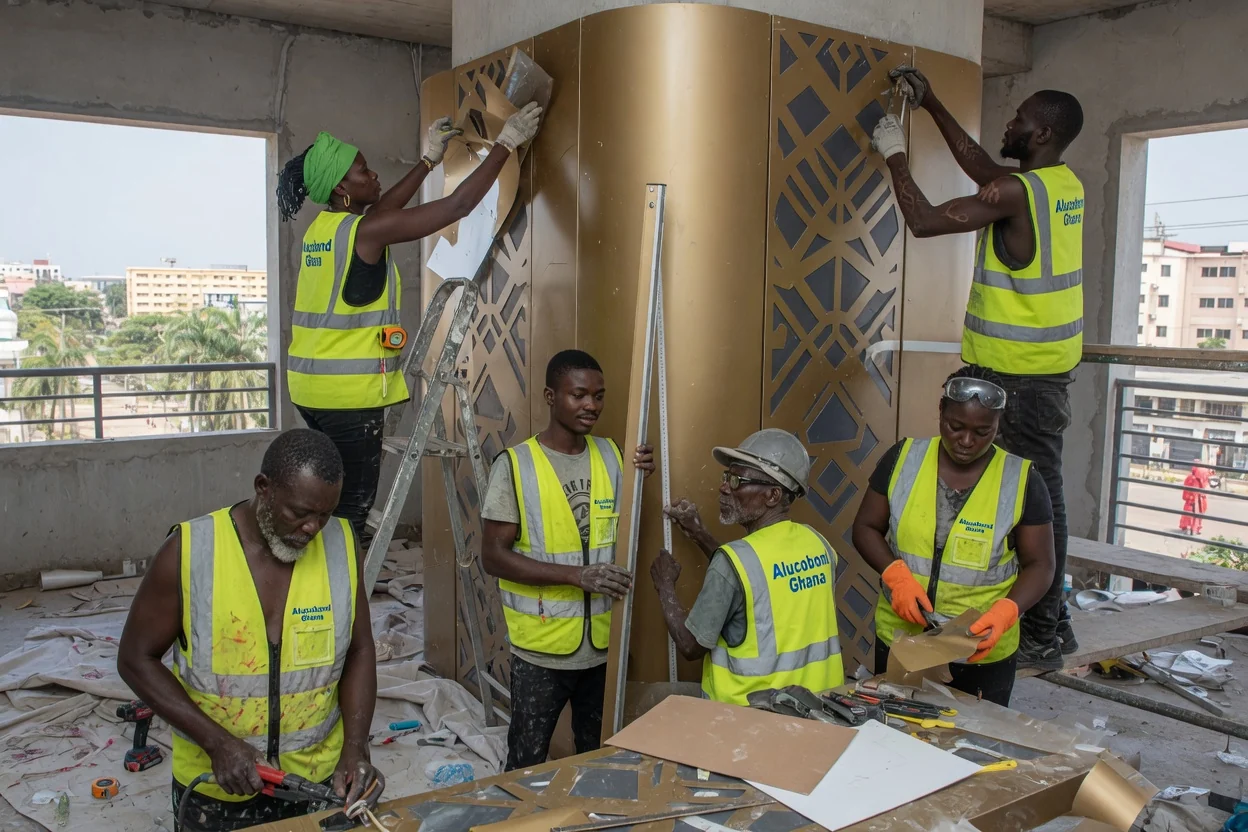
A tower elevation is a single visual field seen from distance. We specify panel flatness, PVDF or anodised coating and joint geometry so the façade reads as one plane — corporate colour matched to brand standard, shadow gaps aligned, feature reveals and crowns fabricated to detail.
A rain-screen engineered for the long horizon
The ventilated cavity behind the panel keeps the structure dry, manages thermal movement and lets the façade weather without trapping moisture against the building. On a tower, that cavity — and its fire barriers — is engineered work, not an afterthought behind the panel.
A core specified to height and occupancy
Taller, continuously occupied towers raise the fire question directly. The core — PE, FR or A2 — is specified to the building under EN 13501-1, named in the documentation, and handed over as evidence. We tell you what is on the wall.
Our Corporate Cladding Scope
- Commercial ACP Cladding — corporate tower and HQ façades
- Rain-Screen Systems — ventilated ACP façades engineered for towers
- Fire-Rated ACP Cladding (PE vs FR vs A2) — the core decision for high-rise, documented
- Anodised Aluminium Panels — bronze, champagne and silver anodised elevations
- ACP Cladding Cost Guide — material vs installed, quoted on survey
Standards & Fire Safety
An aluminium composite panel is two thin aluminium skins bonded to a core, and the core decides the fire behaviour. We specify and document against the real standards:
- EN 13501-1 — reaction-to-fire classification. Cores are PE (combustible), FR (fire-retardant) or A2-s1,d0 (limited combustibility). High-rise and continuously occupied towers are specified toward a non-combustible A2 core, named by Euroclass in writing.
- ASTM E283 / E331 / E330 — façade performance: air infiltration (E283), water penetration under static pressure (E331), and structural performance under wind load (E330) — the loads a tall Accra elevation actually sees.
- EN 1090 — execution of aluminium structures, governing the sub-frame and fixings as engineered work.
The honest position: a non-combustible panel on a poorly detailed cavity is not a fire-safe façade — so we engineer the system, name the core, and never claim a rating a panel does not hold.
Corporate Façades Across Accra
Alucobond Ghana specifies and installs office-tower façades across Ridge, Airport City, the Accra CBD and Cantonments, with work in Tema. From a single feature crown to a full curtain of cladding, the standard holds: a flat, brand-true elevation over a documented core.
Façade cladding is quoted on survey — panel grade, height, access and finish decide the figure; indicative ACP material references run roughly US$2–8/m² before fabrication, sub-frame and installation, with the full picture on the ACP Cladding Cost Guide.